

I’ve argued for the past decade that the radio and advertising industries have been operating with an outdated view of who matters most. I’ve written about it, questioned it on social media and have led discussions about it at our annual Summits. We’ve even let others use this website to examine the issue.
Yet the obsession with Adults/Men 25-54 has been treated as gospel for so long that many in our business forgot to ask a simple question: Does it still reflect reality?
Audacy’s Latest Research
I read through Audacy’s newest research piece last week presented by Ray Borelli, Reggie Shah and the company’s Insights team. It provided serious data and sound logic to a conversation that needs greater attention. If you haven’t read it, take some time and do so. It’s worth it.
Their case for expanding the industry’s primary buying demo from Adults 25-54 to Adults 25-64 isn’t just persuasive — it’s overdue. Audacy didn’t provide a hot take, corporate press release or dress this up as insight. It was well-researched, thoughtfully presented and highlighted real audience behavior and economic reality.
The industry should be paying attention because this affects everyone not just Audacy.
Adulthood looks different today than it did when the 25-54 demographic standard was created. Audacy points out that shifting from Adults 25-54 to Adults 25-64 expands radio’s national audience from 107 million to 140 million people — a 31% increase in reach and 33 million additional adults.
Think about that for a moment.
Without creating a single new show, hiring a single new host, or flipping a single format, radio instantly becomes dramatically larger, simply by measuring the audience in a way that reflects modern life.
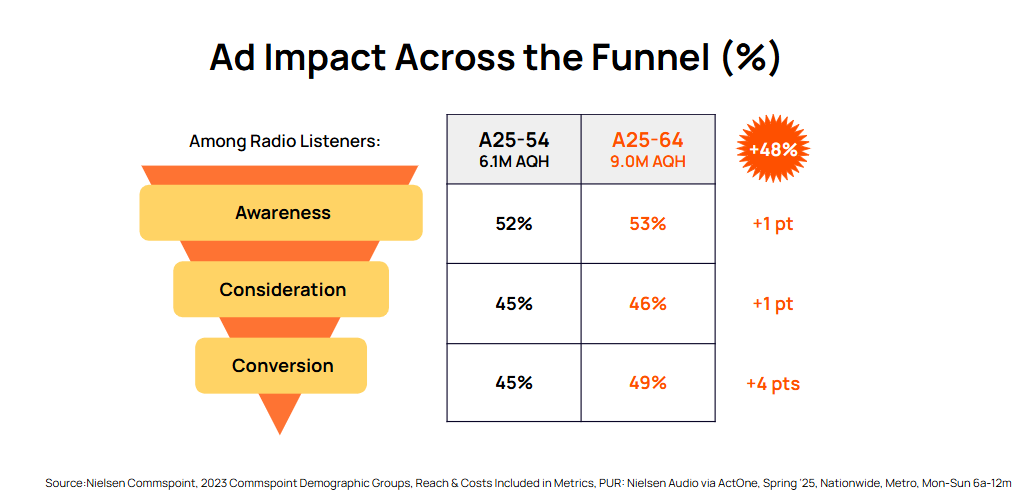
And the best part? The economic quality of the audience doesn’t decline. In fact, homeownership rates increase and income levels remain strong across the broader group.
That’s not theoretical upside. That’s measurable business opportunity.
Audacy’s research even showed a four-point lift in conversion among exposed listeners within the broader demographic. That’s the kind of performance metric advertisers claim they want. If the goal of advertising is to drive results, why would we intentionally ignore millions of consumers with proven spending power?
Mike Francesa Has Said This For Years
If this argument sounds familiar, it should. Mike Francesa has been pounding the table on this issue for years.
Francesa has repeatedly challenged Nielsen and the advertising community to stop ignoring older audiences. His point has always been straightforward: Americans are living longer, working longer, and spending longer. Media consumption habits have evolved, but measurement standards haven’t kept pace.
Mike joined me at our conference in New York City in 2020 and emphatically called on Nielsen and the advertising industry to look at this issue with fresh eyes He cited how the majority of buying power in this country sits with older consumers. Cars, travel, financial services, insurance, and home improvement aren’t categories dominated by 27-year-olds. They’re dominated by adults who have established careers, families, and assets.
Francesa understood something many programmers and sellers learned firsthand: loyal audiences often skew older, and loyal audiences drive consistent revenue. Audacy’s work reinforced exactly what Mike has been saying.
The 55-64 audience segment represents a significant share of households and spending, and retirement ages continue to climb. That’s not a niche group. That’s a major economic force.
The Industry’s Comfort Zone Has Become Its Limitation
The advertising industry didn’t land on Adults 25-54 by accident. For decades it represented the sweet spot of consumers establishing households and brand preferences.
But that model was built for a different era.
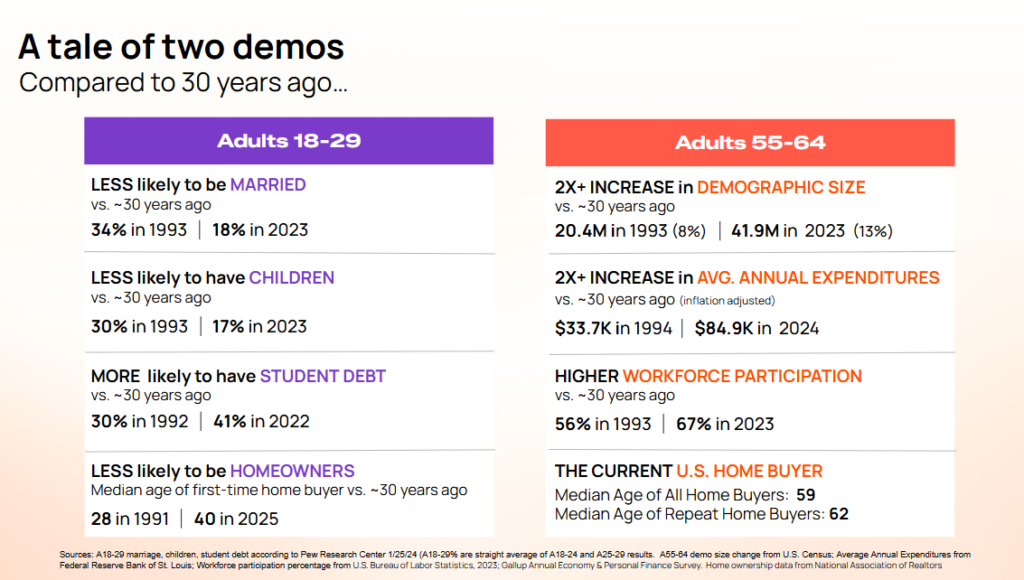
People bought homes earlier. They started families earlier. They retired earlier.
None of those assumptions hold up the way they once did.
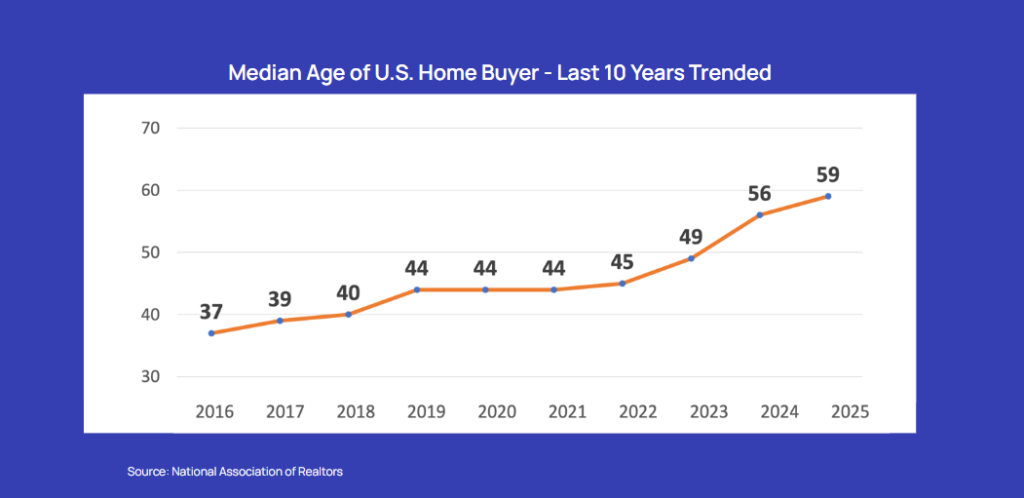
Today, the median age of a first-time homebuyer is 40, and the median age of all homebuyers is nearly 60. That reality alone should make every media planner reconsider how they define “prime consumers.”
Yet the industry continues to cling to 25-54 as if it were a law of physics rather than a marketing convention. Radio has paid the price for that inertia. Stations routinely deliver strong total audiences and highly engaged listeners but struggle to monetize them because the measurement currency ignores a meaningful portion of their value.
This isn’t a programming problem. It’s a measurement problem.
Nielsen Needs a Fresh Look
Nielsen deserves credit for the role it has played in helping radio demonstrate its value. Ratings have been important to many companies throughout the years. However, many larger groups have lost trust due to rising costs, small sample sizes, and an unwillingness to evolve and consider new information.
It’s no secret that measurement systems don’t capture the current climate effectively. Groups like Cumulus, Good Karma Brands, Saga, Townsquare and others have found ways to run their businesses without Nielsen. If expanding a demographic from 25-54 to 25-64 more accurately reflects how modern consumers live, work, and spend, which benefits the brands and advertisers paying Nielsen for the information, what exactly is the argument against it?
We’ve seen Nielsen make methodological changes before such as adjusting PPM rules and refining measurement standards. Why wouldn’t they want to provide a better snapshot of what’s actually happening?
The industry has an opportunity to rethink the foundation of its buying currency. Inflating numbers artificially isn’t necessary. All groups need is to represent reality more accurately.
This Is Bigger Than Radio
What makes Audacy’s argument particularly compelling is that it isn’t just about helping radio look bigger. It’s about helping brands make smarter decisions. Ignoring millions of consumers with high incomes and active buying behavior doesn’t make advertising more efficient. It makes it less effective.
Audacy’s research makes clear that expanding the demo aligns measurement with how adulthood actually works in 2026, not how it worked in 1986.
That’s a critical distinction.
Media habits have changed. Life stages have changed. Economic realities have changed. Measurement standards must change too.
Key Demographic Changes (1986–2026)
- Aging Population: The 65+ population has grown substantially, with the oldest boomers turning 80 in 2026. The 80-plus population is projected to double between 2025 and 2045.
- Increased Diversity: The population is more diverse, with significant growth in Hispanic, Asian, and multi-racial populations. Hispanics have jumped from roughly 18-19 million in 1986 to approximately 68 million in 2024. The Asian population grew from roughly 11.9 million in 2000 to 24.8 million by 2023. And the Black population grew from 36.2 million in 2000 to 49.2 million by 2024.
- Increased Education: The percentage of the voting-age population with a college degree has roughly doubled.
The Data Can’t Be Ignored
In the mid-1980s, wealth was concentrated in older, but not exclusively retirement-age, households. According to research on wealth trends in 1983, households headed by persons between 45 and 69 years of age held the largest share of wealth.
Fast forward to 2026, and wealth is now heavily concentrated in the oldest living generations, specifically those who have already retired or are nearing retirement. As of early 2026, Americans in their 60s and 70s are the wealthiest, with average net worth’s exceeding $1.4 million, according to data from Empower. Baby Boomers (born 1946–1964) are the wealthiest, holding more than half of all U.S. household wealth, despite making up less than 20% of the population.
The U.S. population has soared from approximately 240 million in 1986 to a projected 348 million in 2026. Our demographic center is shifting rapidly toward older age groups and a more diverse, and educated, yet smaller, younger generation.
Conclusion
To summarize, consumers are smarter, larger, wealthier, more diverse, and living longer. Yet our industry continues to prioritize the same demographics as if we’re living in 1986.
That needs to change.
Adults 25-64 isn’t a radical idea. It’s a realistic one. Heck, I’d be fine if Nielsen tweaked it to 29-64 or 31-64. Either way, it’s more reflective of the modern world we live, consume and make purchases in.
For years, many have challenged Nielsen and advertisers to recognize older audiences. Audacy deserves credit for putting real data behind it. The Insights team didn’t just suggest a demographic reset, they made a credible business case for it. And they did so with clarity, evidence, and practical logic.
The question now is whether the advertising community and Nielsen care to listen.
Radio doesn’t need artificial growth. It needs its real audience counted. If the goal is to help brands succeed while accurately valuing one of America’s most powerful media platforms, then a demographic reset isn’t just logical — it’s necessary.
Barrett Media produces daily content on the music, news, and sports media industries. Sign up for our newsletters to stay updated and get the latest information right in your inbox.

