
For every headline claiming sports radio is in decline as more content players invade the space, there are always studies that provide stability for the industry as a whole. Each year, the research team at Cumulus Media and Westwood One, led by Chief Insights Officer Pierre Bouvard, offers a glimpse into the continued power sports radio still holds.
Last month, Bouvard and his team released another study finding that sports radio on the AM/FM dial remains a dominant force. The study showcased the format across every metric, from increases in streaming audience and revenue shares to the number of stations nationwide. Much of the growth in sports radio has occurred as more stations move from the AM band to FM simulcasts.
“Ten percent of all American radio listening is going to AM. Ninety percent goes to FM,” Bouvard pointed out. “Let’s say you had a small store in a small mall. Then there’s this other mall that’s nine times bigger than your mall. Wouldn’t you want to have a store in the bigger mall with nine times the amount of people in it?”
For Bouvard, the argument is simple. If sports radio stations continue operating where engagement is limited on the AM band, the path to growth becomes more challenging.
“Music formats come and go. A strong sports brand lives forever,” noted Bouvard. “There is so much new breaking news every day in the world of sports. It’s not playing ‘Stairway to Heaven’ again. Literally, every time you tune in there is something new going on.”
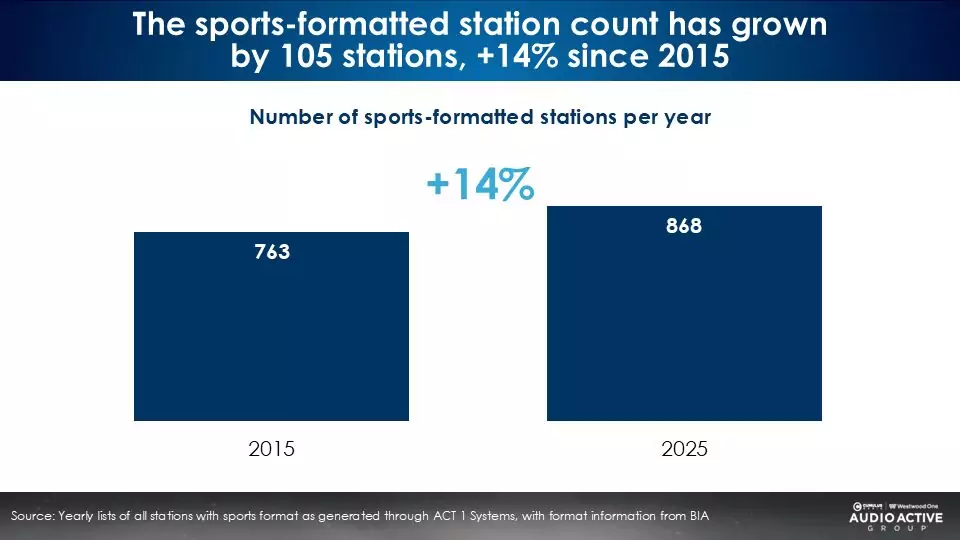
According to Bouvard’s latest project, sports-formatted AM/FM radio stations have grown 14% over the past decade. With more opportunities to capitalize on local talent and expanded inventory, associated revenue has grown in line with the increase in stations. The findings show that revenue shares for sports-formatted stations have also risen — by an astounding 38%.
Another reason companies continue to believe in the power of sports lies in the consumption habits of the sports audio audience. Bouvard’s latest findings state that sports AM/FM radio ranks as the top streaming format among Persons 18–34 and Persons 25–54. Those figures represent nearly four times the total share when over-the-air AM/FM listening is included.
As sports podcasts have risen during the same period, Bouvard acknowledged that podcasting may have taken some share from total time spent listening to sports audio. However, he credits sports radio for adapting to platforms where podcast audiences live.
“Think of podcasts not as something new, it’s just on-demand. It’s giving me the thing I love and when I want it,” explained Bouvard. “That’s a gift to sports radio because we have talent and content people love and want. Making that available is just making what they want and placing it in places when they want it.”
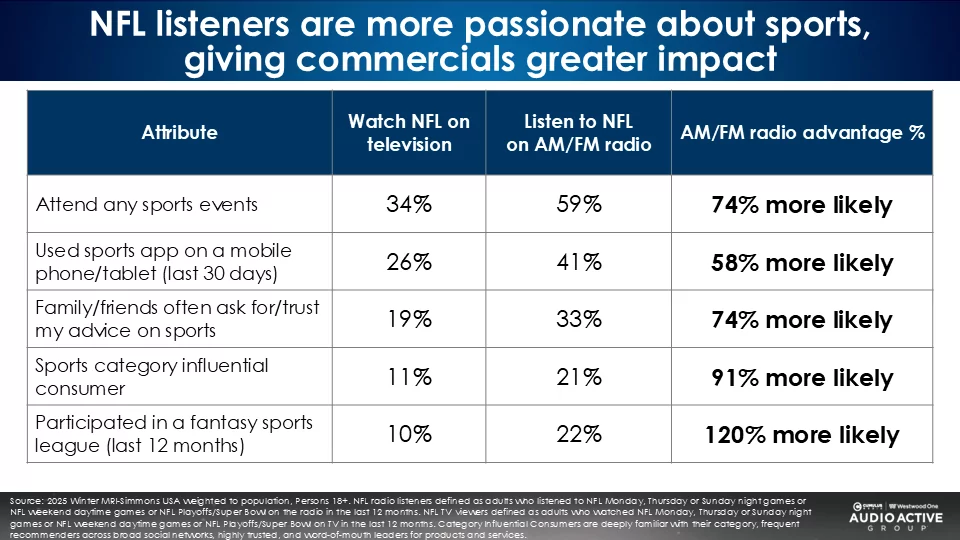
From an advertiser’s standpoint, engagement is where sports radio outshines its competition. Bouvard’s latest research indicates that sports AM/FM listeners engage more actively with advertising. By contrast, sports television viewers tend to consume content more passively. The findings suggest radio audiences lean in. That behavior can translate into deeper interaction with brand messages.
“The rule of thumb is when your ad is playing on television, 25% of the time that ad is playing to an empty room. About 25% is playing to a room with eyes not on the screen. The other 50% when your ad is playing is there someone in the room looking at the TV,” explained Bouvard. “TV is about sight, sound, and motion. You’re only getting that half the time with TV. With sports radio, it’s ears on. With the Nielsen meter, you need to be ears on all the time at an audible level. That’s why advertisers who use sports radio find it works really well for them.”
A significant reason for this advantage is the human-to-human connection sports radio provides — something television viewing often cannot replicate.
“People crave people. Hearing someone’s entertaining voice, we crave that as people. I think sports radio attracts people, and people pay more attention to people,” noted Bouvard. “90% of people commute by car in America alone. That’s a little lonely. But you turn on a sports station and immediately you’re with this fun family of people in the car with you. That’s why advertising works so much better on sports radio.”
That connection, along with the relatively low barrier to entry in the format, helps explain why Bouvard remains confident in its stability despite continued advancements in artificial intelligence. As AI evolves into an everyday tool for media consumers, some question sports radio’s long-term viability. However, Bouvard pointed to similar concerns raised in the past when new technology emerged.
“Remember all the hype in 2017 around ‘Alexa?’ Someone made the prediction that two-thirds of all search will be made through Alexa by 2020. People rarely ask Alexa anything anymore,” said Bouvard.
FOX Sports recently announced its ‘Sports AI with Colin Cowherd,’ a tool that offers users a real-time, on-demand experience with a personalized approach from one of sports radio’s biggest talents. The platform allows immediate engagement, which could reduce the desire to hear the same take repeated if AI can deliver it instantly.
Still, Bouvard believes the technology serves as a complement rather than a replacement.
“Sometimes we see these interactive things as something that people will spend a ton of time with. The reality is we, as people, don’t want to work that hard to be entertained,” said Bouvard. “I can turn on a sports radio station and they entertain me. Day in and day out to use an AI tool to talk to ‘Colin Cowherd, that’s a lot of work. That was the issue with Alexa. We all way overthought what its impact would be. I have no anxieties about Colin Cowherd AI eating all of sports radio.”
The research also provides insight into the sports AM/FM radio audience — one that advertisers actively seek. Findings show a more engaged listener with rising average annual income and stronger interest in major purchasing categories such as automotive, travel, and investments.
With more disposable income and a willingness to spend, the research further indicates that engaged sports AM/FM listeners also enjoy betting on the games they follow. In 2025, the sports betting industry reached a record $16.96 billion in revenue, according to the American Gaming Association.
Bouvard offered caution to programmers and sales teams when interpreting this data. While the figures show above-average interest in sports gambling, stations should avoid adopting an all-in betting strategy without first understanding their specific audiences.
“You want to do a little listener research on your station first. What percent of your audience bets on sports weekly, occasionally, and so on. Every station will be different. People are listening for any number of reasons,” said Bouvard. “The top reason why people listen is to be entertained. We’re not bookies and a tip machine on sports radio. We’re in show business. We need to be careful that we’re here to put a smile on people’s faces and not get obsessed about super serving the frequent sports bettor.”
The future of sports AM/FM radio remains unclear, but its present state shows promise. As station counts, revenue shares, and streaming audiences continue to grow, Bouvard’s latest research suggests sports radio is one of the few formats expanding within the industry today. His roadmap demonstrates that audiences are growing, engaging more deeply than television viewers, and earning higher incomes — positioning them as consumers ready to spend.
That combination makes sports radio a destination advertisers should consider investing in, driven by the power and passion of the sports fan.
“Sports radio’s core mission is to entertain and put on a show,” noted Bouvard. “Sports is the great equalizer. We share our passions no matter our work or backgrounds. That’s the cool thing about sports. It’s not a class thing, it’s just something that’s very entertaining to all people. We need to be where the people are. If it’s FM, podcasts, YouTube, we need to be there. The good news is sports radio content works well in all those different platforms.”
The numbers from Pierre Bouvard and the Cumulus Media research team do not reflect a format in decline. Instead, they depict a format that understands its audience — one that knows where listeners are heading and meets them there, whether on FM, on-demand, YouTube, or during a solo commute home.
Sports radio’s power has never been about the signal. It has always been about the connection. As long as sports fans crave trusted voices, authentic conversations, and personal entertainment, sports radio will continue to earn its seat at the table.
If the latest research offers any indication, that seat is not shrinking. It is expanding.
Barrett Media produces daily content on the music, news, and sports media industries. Sign up for our newsletters to stay updated and get the latest information right in your inbox.

