
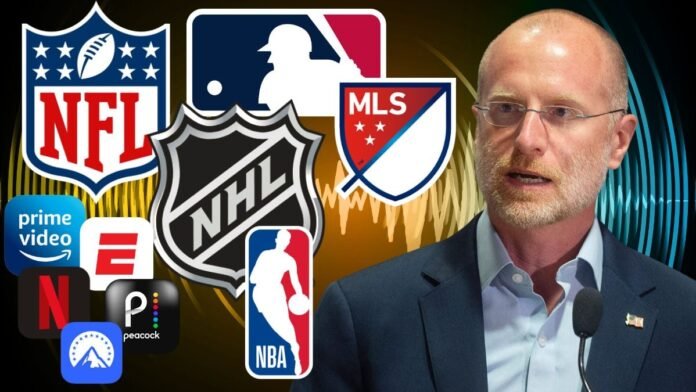
Somewhere between cable dying and streaming taking over, watching sports became a second job. No benefits, no vacation days, and the onboarding process involves downloading four apps, resetting two passwords, and arguing with your television.
I know this because my inbox tells me so every single week, and a suspicious number of those complaints come from AOL addresses.
The federal government has finally noticed too. The FCC has issued a formal public inquiry into the distribution of live sports on television. They’re asking whether the current broadcast landscape serves the public. Whether media contracts violate federal law, and if the Sports Broadcasting Act of 1961 — written when color TV was still a novelty — needs a complete overhaul.
Now here’s the thing that’s going to surprise you. Those inbox complaints from the AOL crowd almost always come from NFL fans. While I have sympathy for their confusion, I’m about to tell them something they won’t want to hear.
NFL fans have absolutely no idea how good they have it.
Why? The NFL is not the hardest sport to find on television. Not even close. Want to know which fans are really suffering?
Let’s start with the NFL, which is complicated but manageable — if you’re under 50.
Yes, the NFL put games on ten different platforms this past season.
CBS, Fox, NBC, ABC, ESPN, Amazon Prime, Peacock, Netflix, YouTube, and NFL Network. Watching every game costs roughly $823 in subscriptions annually. It’s not cheap, but the NFL knows you’re addicted. The games will likely all be streaming sooner rather than later.
Sorry, gramps.
If you have Amazon Prime, you found Thursday Night Football. If you have Netflix — which 300 million people do — you found the Christmas games. The NFL’s “fragmentation problem” is mostly generational. Fans under 40 aren’t lost. They’ve got the apps, they know the passwords, and they’re watching. The ones who can’t find the game are navigating streaming services by calling their grandchildren.
The FCC’s inquiry focuses directly on whether leagues are serving all fans — not just the ones who know which button does what on a Roku remote.
It’s a valid question, but NFL fans aren’t leaving. There is no price point that makes an NFL fan tap out. The NFL could broadcast games exclusively from a submarine, and fans would buy a submarine.
Now let’s talk about the NBA, which somehow managed to make the NFL look simple.
Fresh off its $77 billion media rights deal, the league debuted a new broadcast universe this season. It is glorious. It is also completely baffling. NBC and Peacock own Mondays and Tuesdays. ESPN has Wednesdays. Amazon Prime takes over Thursdays once the NFL clears out in January and shares Fridays with ESPN all season.
ABC gets Saturday nights. NBC and Peacock close out the week on Sundays. The Play-In Tournament? Amazon exclusively. The Finals? ABC.
There are 247 national games this season, up from 172 last year. That’s more basketball than ever — accessible to anyone who has four subscriptions and has memorized which service airs on which night of the week.
Here’s the sport nobody expected to come out looking reasonable: hockey.
The NHL’s national setup — ESPN, ABC, and TNT/TBS — is genuinely manageable. No streaming exclusives at the national level, Peacock playoff surprises, or Netflix Christmas specials. There are 172 national games, mostly on channels you’ve heard of.
The Stanley Cup Final requires ESPN. If you don’t have it on cable, ESPN Unlimited is $30 a month to stream, which stings. But compared to every other sport on this list, the NHL is practically broadcasting in the town square.
Now Major League Baseball — sweet, nostalgic, completely unwatchable baseball.
A sport so committed to being hard to find that it secured a deal with Roku last year for exclusive Sunday afternoon games. The Roku Channel is free, which is the nicest thing you can say about it. That’s now over.
This season, MLB has three-year media deals beginning with ESPN, Netflix, and NBC. National games and events on each. Then when you get to the postseason, a different network every round. Good luck.
The real disaster is local. FanDuel Sports Network — formerly Bally Sports, formerly Fox Sports Regional Networks — is shutting down this spring. After missing rights fee payments, all remaining nine of its MLB clubs — the Braves, Reds, Tigers, Royals, Angels, Marlins, Brewers, Cardinals, and Rays — have already terminated their contracts.
MLB says it will step in and produce games for at least six of those teams through its own media arm. Whether those solutions arrive on time, at a fair price, and are actually findable is genuinely unknown. Opening Day is only three weeks away.
College football, oddly enough, is the one that mostly works.
There are 130 teams, dozens of conferences, and a rotating cast of networks. Somehow, it’s one of the sturdier landscapes in sports media. ESPN owns a massive chunk. FOX Sports has the Big Ten. CBS does too. Playoff games are spread around but mostly remain on linear TV. You can still watch a lot of college football with a plain antenna and a couch.
The biggest issue is that so many good games are on at the same time on a Saturday, but that’s what the quad box is for.
So, who saves us?
The FCC’s inquiry asks whether any of this serves the public. Also, whether local broadcasters are meeting their legal obligations, and if the Sports Broadcasting Act of 1961 needs updating. The world is different than all those years ago. Today is a world where your team’s game appears on a stick plugged into your television that also streams cooking shows.
The cynical answer: the FCC probably can’t do much. Its jurisdiction over streaming is murky. Netflix and Amazon don’t answer to it the way broadcast stations do. The agency’s sharpest weapon is noise — enough of it that Congress eventually acts.
Which, knowing Congress, puts meaningful reform somewhere around 2041.
The market is already doing some of the FCC’s work. The RSN collapse is ugly, but what’s replacing it — league-produced broadcasts, direct-to-consumer apps, and over-the-air local deals — could end up more accessible than the old “pay $8 a month for a regional sports network you can’t stream” model ever was.
If MLB consolidates local rights into a clean package without blackouts, that’s genuinely better for the cord-cutter. That won’t be till at least 2029 if ever.
The NFL fan will pay whatever it costs and figure out whatever platform is required. Always has. Always will.
The baseball fan, the NBA fan, and the hockey fan watching their regional network go dark need someone — the FCC, the leagues, anyone with authority and a sense of urgency — to make this coherent before the last regional sports network flickers out and the game just… disappears.
Barrett Media produces daily content on the music, news, and sports media industries. Sign up for our newsletters to stay updated and get the latest information right in your inbox.

