
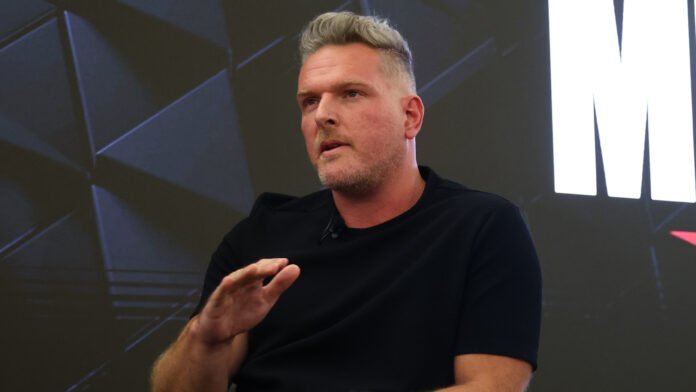
There is no doubt that Pat McAfee gets the biggest names in sports and entertainment to join his program. This past week, following a short hiatus after the Super Bowl, McAfee was live and in charge at the NFL Combine in Indianapolis. He personally works alongside the city of Indianapolis to bring the biggest events to his home market. I wouldn’t be shocked if he were personally involved in bringing several WWE events to town, along with serving as the emcee of the city’s recent announcement that the NFL Combine will remain in Indianapolis for 2027 and 2028.
It seems only fitting that the city’s favorite adopted son would have the biggest stage at the NFL Combine last week, and he did — front and center with the field at Lucas Oil Stadium as his backdrop. The three days in Indianapolis were not disappointing. The guest list would make any other sports content program envious. NFL general managers and head coaches. Gold medal-winning hockey players. Even an appearance from the Governor of Indiana, who is attempting to lure the Chicago Bears to the state for a new stadium.
More than ten hours of content were created, including twenty interviews. While the roster was impressive, what did it leave the audience? What stood out from the three days in Indianapolis? While the lineup of appearances was indeed impressive, does McAfee use the moment differently than any other sports talk talent would? And if so, is that what the audience expectation should be?
It’s unfair to compare what McAfee’s brand does to a typical local sports radio station. However, what is comparable is the approach. For example, whenever a big event offers a “media row” setting, sports radio outlets chase exclusivity. They want the ability to land a guest they typically would not get time with because they are “broadcasting from the house.”
The NFL Combine provides a unique window of exclusivity. NFL owners, coaches, general managers, and prospects looking to impress ahead of the NFL Draft are all “in the house.” It’s a rare opportunity unmatched at any other point during the year. There is a chance to spend time with nearly anyone in the National Football League who is constructing rosters or auditioning for draft selections.
McAfee caters to a national sports audience through his YouTube platform and ESPN simulcast. His reach extends beyond a single market, unlike many of the sports radio brands that attended the NFL Combine’s “radio row.” ESPN Radio, FOX Sports Radio, and Westwood One Sports did not broadcast live from Indianapolis. Jim Rome, Dan Patrick, and Colin Cowherd all remained in their studios.
SiriusXM NFL Radio, a partner with the NFL, broadcast live from Indianapolis with its full daytime lineup “from the house” all week. If we’re comparing apples to apples, the guest roster for SiriusXM NFL Radio was equally, if not more, impressive.
When you don’t spend thirty to forty minutes with a guest, as McAfee often does, you can create more variety and depth in the interviews you present.
Comparing how McAfee and SiriusXM NFL Radio handle their interview schedules is like comparing podcasting to radio. That’s the element McAfee has always mastered. He’s a podcaster that radio executives continue to study in hopes of replicating the attraction.
His interviews aren’t interviews; they’re conversations. He elevates the ego and rarely puts the subject in an uncomfortable position.
It’s not softballs, as many often suggest. Rather, the approach is to protect the shield. Athletes, executives, and key personnel view McAfee as a safe space. They know his style isn’t the typical Q&A filled with wasted minutes.
It’s more like chilling with your buddies than conducting a topical interview designed to make news.
McAfee doesn’t often make news with his interviews. He doesn’t need to, despite the star power he attracts. But isn’t the old rule of thumb that the quality of an interview is based on the answers you get instead of the questions you ask?
Maybe times have changed. The audience may no longer value probing questions — they value authenticity and vibe.
This week, we learned that Tennessee Titans head coach Robert Saleh’s wife has sex with him while he sleeps. WWE Superstar Randy Orton said he would love to ‘RKO’ Tom Brady. Plus, Team USA stars Jack Hughes and Megan Keller joined the show for more than an hour combined, and not one answer from either interview truly stood out.
Is that capitalizing on the moment with the platform you’ve been given? Is there value if there’s no insight to gain? McAfee has already established trust with every celebrity who appears on his program, but what memorable moments is he really creating for the audience?
Does he even have to create moments? Or is the value McAfee brings more aligned with what a podcasting listener desires more than traditional broadcasting audience?
For McAfee, it works — and it has for some time. It’s taken him from podcasting to radio to streaming and now to television worldwide. Is his interview approach something sports talent around the country should consider moving forward? Has audience expectation changed so dramatically that style now outweighs substance?
Do answers even matter when the hook to listen has evolved into what a podcast audience desires? If you get unprecedented access but produce little insight, are you maximizing the moment for The Pat McAfee Show?
McAfee creates an environment where he and the guest sit on the back porch, cracking a cold one. No monotonous questions, just genuine conversation. Where he falls short is in addressing the compelling subject matters that most hosts don’t ask — or don’t think to ask. He has the opportunity, but he rarely (if ever) takes a swing.
He’s never done what people expect; he does what he feels. It’s the motto his entire media empire has been built on. Why continue to do what has always been done when you can craft your own lane and leave others questioning theirs? Why even take the swing?
Access has never been McAfee’s issue. What he does with it raises the bigger question. The danger is whether it’s becoming predictable in a world that craves something new and fresh in entertainment.
Pat McAfee’s numbers say he’s winning. The influence says he’s winning. The access says he’s winning. For now. But the question isn’t whether he’s successful. It’s whether the moment is being maximized and are these wasted opportunities going to lead to the audience craving something more substantial?
In a world where everyone is fighting for bookings, he’s already won. The stage is his. The guests line up. The cameras roll. Eventually, however, access alone stops being the differentiator. What separates great from influential isn’t who you can get — it’s what you can get out of them.
Then again, maybe the modern audience truly prefers the hang over the headline. Maybe comfort beats confrontation. And maybe that’s not a flaw — it’s simply evolution.
However, if every conversation becomes safe and every moment predictable, even the biggest platform risks blending into background noise. McAfee built his empire by being different. The real challenge now isn’t getting the room. It’s doing something in it that no one else can.
Barrett Media produces daily content on the music, news, and sports media industries. Sign up for our newsletters to stay updated and get the latest information right in your inbox.

