
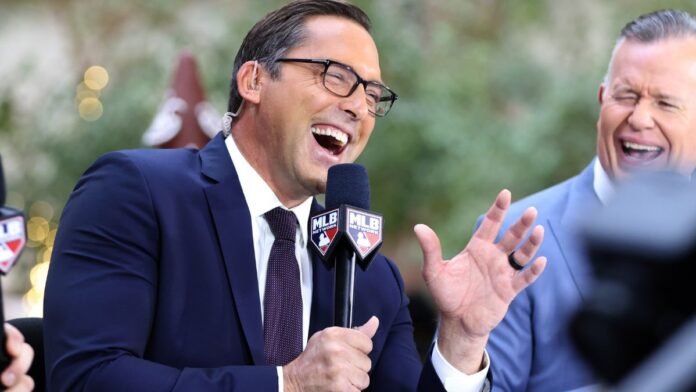
Team USA manager Mark DeRosa was roasted by sports media across the country yesterday. Rightfully so. Despite his team’s impressive win over Mexico on Monday night, a trip past the pool round of the World Baseball Classic was not guaranteed. DeRosa thought the opposite and said as much on the MLB Network program Hot Stove.
“It’s weird, we want to win this game [Tuesday night’s contest vs Italy] even though our ticket’s punched to the quarterfinals,” he said on Hot Stove. “The way the schedule lines up, this is an important game for us.”
Yes, an important game. One that, if the United States secured victory over the Italians on Tuesday, would have locked in a ticket to the knockout round. It didn’t. Instead, Team USA had to wait for the result of Wednesday night’s matchup between Italy and Mexico to determine its fate. DeRosa’s mistake was obvious. The rules were clear, and the manager of Team USA didn’t appear to understand them. But while DeRosa’s comments were embarrassing, MLB Network made the bigger mistake.
The network removed the video of DeRosa’s appearance from its website, essentially covering up the error.
Mark DeRosa is no fringe figure in the baseball world. He is a two-time manager of Team USA in the World Baseball Classic and previously played for the national team during the 2009 tournament. A decorated former player, DeRosa has also been a prominent analyst on MLB Network since joining the channel in 2013.
Despite never holding a managerial position in Major League Baseball, he has now twice been selected to lead the United States’ all-star roster in the WBC. However, comments like the ones he made Tuesday afternoon could jeopardize his chances of future involvement with USA Baseball.
It’s difficult to understand why anyone would entrust him with managing a roster filled with the best talent in the world if he doesn’t fully grasp the tournament’s advancement rules.
Still, DeRosa’s mistake wasn’t the most troubling part of this situation.
MLB Network — which is owned and operated by Major League Baseball — pulling the video from its website was irrational. According to multiple reports, the clip was removed to avoid confusion about the quarterfinals after DeRosa provided incorrect information.
So it’s entirely DeRosa’s fault? No.
He was being interviewed by the hosts of Hot Stove, correct? If DeRosa was wrong, shouldn’t either Matt Vasgersian or Harold Reynolds have corrected their MLB Network teammate following the error? A true example of the lost art of listening by interviewers was on display.
But, people make mistakes on live television all the time. In fact, that’s part of the appeal. Live TV carries a level of unpredictability that recorded programming simply cannot replicate.
DeRosa made a mistake. It happens. What networks should never do is attempt to erase those mistakes. That’s what MLB Network unfortunately did. Trying to cover them up only makes the situation worse and damages trust between the network and its audience.
I’m not naive enough to believe this is the first time a network has withheld comments from on-demand consumption. Nor am I naive enough to think that networks and stations don’t edit out mistakes when posting clips online.
But this situation went a step further.
According to The Athletic, after Team USA lost to Italy on Tuesday night, MLB Network posted a trimmed version of the interview on Facebook with DeRosa’s comments edited out.
That raises an obvious question: Which was the bigger mistake? The manager not knowing the rules, or the league-owned network quietly trying to protect one of its own? It’s one thing to decide not to post the interview at all. It’s another to post it in an edited form that removes the controversial portion.
To MLB and MLB Network’s credit, the full interview — including DeRosa’s comments — was later restored to MLB’s website while this column was being written. But the episode still reveals questionable judgment.
This isn’t about balls and strikes or debating whether a double steal was executed properly. DeRosa’s comments involved the rules for advancement in a contrived international tournament that already asks fans to follow a complicated scoring format. In this event, advancing isn’t determined solely by wins and losses. Run differential also plays a role — essentially borrowing tie-breaking principles from international soccer.
And if the television ratings are any indication, the World Baseball Classic still hasn’t captured the full attention of the American sports fan like an Olympic style competition should.
Yes, DeRosa’s comments were embarrassing. But the attempted cover-up revealed something far more concerning: the insecurity Major League Baseball appears to have about the public image of its own personalities.
Media brands across the country should take note. When someone on your air makes a mistake, the best response is usually the simplest one: own it. DeRosa eventually did, though only after his employer had already tried to make the moment disappear.
Brands should also understand the risks of selective editing and content control. When audiences catch you manipulating the record, the backlash can be severe. Trust erodes quickly.
And in today’s fractured media environment, trust may be the most valuable currency any network has.
Viewers understand that analysts misspeak. Hosts get facts wrong. Managers say things they wish they could take back. That’s part of live television and, frankly, part of what keeps it authentic. Sports fans don’t expect perfection. They expect honesty.
What they don’t expect is the league’s own network quietly trying to erase the evidence.
Ironically, DeRosa’s mistake likely would have disappeared within a news cycle or two. Analysts say incorrect things on sports television every day. People laugh, social media moves on, and the next story takes over.
But when a network tries to rewrite the tape, the original mistake stops being the story. The cover-up becomes the story. And that’s the real lesson here for media organizations everywhere. Transparency builds credibility. Editing history destroys it.
Sometimes the best thing you can do when someone on your air makes a mistake is the simplest thing of all.
Let the tape speak for itself.
Barrett Media produces daily content on the music, news, and sports media industries. Sign up for our newsletters to stay updated and get the latest information right in your inbox.

