
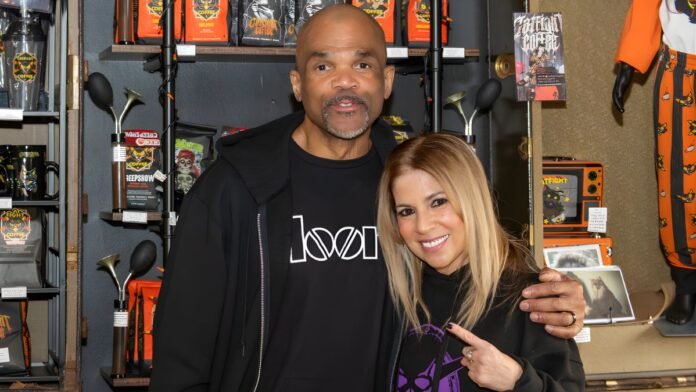
I have known Darryl “DMC” McDaniels personally for close to 20 years. He is one of my favorite people on the planet. In all my years in rock radio, this hip hop legend has still been the most incredible interview to grace my airwaves.
McDaniels was a regular on my radio show because he is a musical and cultural encyclopedia. Always bringing positivity and inspiration. He’s a rocker and rock star in his own right.
McDaniels is a founding member of the iconic Run-D.M.C. He’s a Rock and Roll Hall of Famer, best-selling author, comic book creator, philanthropist, and survivor. He’s always making music with everyone, and with no boundaries. McDaniels has collaborated with rock royalty such as Myles Kennedy, Santana, Agnostic Front, and Sammy Hagar. The list is endless. He fits everywhere, and everyone loves working with him.
Run-D.M.C. made history in 1986, bringing Aerosmith back from the dead and merging rock and rap long before Korn, Cypress Hill, and Linkin Park were born. In fact, they started the process in 1984 with their debut, Rock Box, featuring live metal guitars courtesy of Eddie Martinez.
McDaniels just released a slamming new single, She Gets Me High, sampling the Ram Jam classic Black Betty. It also features Sebastian Bach on vocals, Mick Mars on guitar, Duff McKagan on bass, with Travis Barker on drums.
He gave me some information on his new album, America, which will drop at the end of the summer. The effort features collaborations from Joan Jett and Sammy Hagar.
I caught up with McDaniels at a local NJ coffeehouse, Catfight Coffee in Boonton. We taped my Carr Stereo Podcast, where we hipped and hopped through his early days, Hall of Fame induction, his love of local radio as a kid. Also his recent efforts crafting new music as an independent artist.
*Editor’s Note: Answers have been edited for clarity and length.*
Terrie Carr – I know hip hop came before Run-D.M.C. But you guys did something completely different.
Darryl “DMC” McDaniels – We took it global.
TC– You also did something that I don’t think you get the credit for, because you got the credit when you merged with Aerosmith. You merged rock and hip hop before that, way before that. I remember seeing and hearing Rock Box, because that was one of the first hip hop videos on MTV ever. The thing I remember the most was Eddie Martinez on guitar!
Eddie was most memorable because I had never seen a hip hop video with a guy out front playing a guitar solo at the very beginning of the video.
DMC– Yeah. On top of the Cadillac.
TC– The video was so great. There was a little white kid running around, and Eddie’s there. I had never seen anything like it at the time. It was groundbreaking. The director who put that together was brilliant.
Coming from the early days of hip hop. People such as Kurtis Blow, Grandmaster Flash, and Melle Mel. They made different records than Run-D.M.C.
DMC– We were trying to do a record like Billy Squier. We wanted to make a record like Billy Squier’s Big Beat.
TC– You guys wanted songs, and you had them.
DMC– It was because of the radio. Hip hop today ain’t even hip hop. It’s inspired by hip hop, but that’s a whole other story.
We grew up with New York City radio. In the beginning, it was the black station and the white station. But then 77 WABC did something groundbreaking. They started playing the black music and the white music together.
When I was younger, you would have to listen to WWRL. You would have to listen to that station to get the black music. You had to listen to other stations to get the white music. But on 77 WABC, you could hear Sly and the Family Stone and Crosby, Stills, Nash & Young together. You could hear Elton John, James Brown., Aretha Franklin, and Joni Mitchell.
We were children of that. The hip hop generation is made up of children of late ’60s and ’70s radio. Everybody is a child of that. On Saturday mornings, besides the cartoons for every kid — Black, white, Italian, Asian — there was Soul Train at 12 o’clock.
TC– Get on the line dance, baby.
DMC– Then you still didn’t go outside until 2 because at 1 o’clock on ABC there was Dick Clark with American Bandstand. All of that music was us.
When we started doing hip hop, we utilized the records we were hearing on Soul Train, American Bandstand, and 77 WABC. Our inspiration wasn’t about color. It was about vibration and sound.
Growing up, I loved Harry Chapin, Jim Croce, Bob Dylan, and all of the folk music. That was our music. Ginger Baker said, “it’s just F*****g music. You don’t separate it, it’s just music.” He got mad at the industry for trying to separate it.
I’m a rock guy, so I agreed with Gene Simmons. All my friends cursed me out. Gene Simmons said the Rock and Roll Hall of Fame was really made for bands and musicians. You could argue and say they should have created an annex for soul music, hip hop, and everything else.
The Rock and Roll Hall of Fame people what’s the criteria to get in. Because I agreed with Gene since I’m a rock fan.
They said, “Darryl, if you take a flute,” and I cut them off. I questioned if taking a flute meant you’re playing in the band. They followed up saying, “If all you have is a flute and you sell out Madison Square Garden three nights in a row, that’s some rock and roll s**t.”
All of Run DMC’s hits are rock songs. Taken from rock songs. It’s Tricky is My Sharona. Mary Mary is The Monkees. We all grew up this way. Coming home from school, after your mother and father would tell you is do your homework and eat your dinner. You’d turn the TV on and it was The Brady Bunch, The Monkees, and Fred Flintstone.
With Run-D.M.C., at first hip hop it was Black music. It was about what was going on in the Bronx and Harlem. When hip hop came over the bridge from the city into Queens, we were in the suburbs. So, we had drugs and gangs.
TC– But you also had college.
DMC– We also had college, double dutch, and hopscotch. When I got into hip hop, Bob Dylan and all these people talked about politics and social issues. They also talked about your grandmother.
I asked why isn’t nobody rapping about the other things like that? There were black kids in my hood who were ashamed to wear a Judas Priest shirt because they thought you weren’t supposed to do that.
But when we dropped Rock Box, those kids felt comfortable to wear their Judas Priest shirt now. The same thing happened for the rock kids into hip hop who were running around in their Misfits shirts. That was us.
TC– You’ve got a new tune out with some incredibly iconic performers.
DMC– The song started like this. I was working with and R&B and hip hop producer. He’s just working on stuff, messing around. He goes to the [New York] Giants game at the stadium. Now, you know at sports games — especially hockey games — during intermission and timeouts, the DJs always play music.
He’s sitting there and Rage Against the Machine, Motley Crue, Guns N’ Roses, Blink-182, and AC/DC comes on. The Rolling Stones, Audioslave, Soundgarden — all of that comes on. Then Walk This Way comes on followed by Ozzy [Osbourne], Black Sabbath, and then Tricky.
He comes back and tells me, “D, we got to do this record.” At the game, Ram Jam’s Black Betty comes on, which led him to saying he’s got an idea and let’s do it.
We did a sampled version of Ram Jam’s Black Betty with me rapping over it. Then we sat down, and he thought about all the music he heard at the game. That’s when he decided to do this record live.
And that’s all he said. So now we have to find some musicians.
They found musicians and put out a killer rebirth of a classic taken from a Leadbelly song. How did Darryl hook up with four rock legends for his new tune? Who is he making a horror film with? What was it like merging with Aerosmith 40 years ago? Which radio DJs inspired him? What is his new album going to be like?
Check out my full hang with Darryl McDaniels on The Carr Stereo Podcast.
Barrett Media produces daily content on the music, news, and sports media industries. Sign up for our newsletters to stay updated and get the latest information right in your inbox.

