
Thank you for checking out ‘The Industry According To’. This series runs each Tuesday, and features radio and record industry executives, managers, programmers, talent, artists, and professionals from all areas of the business world. To be considered as a future guest, email me at keithblackboxgroup@gmail.com.
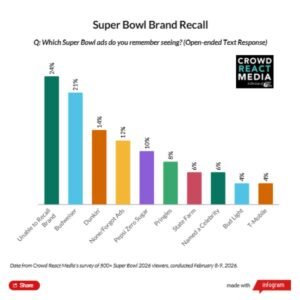
Today we check in with a research and data expert who can decipher audience behavior and data into actional strategies for media brands of all types, Katie Miller, VP of Strategy at Harker Bos Research & Crowd Reach Media. I recently came across data she released from Crowd Reach Media — about consumer recall of brands that advertised during the Super Bowl — and I instantly knew she’d have a lot of great insight.
So, let’s dive in.
What the Data Says and What We Do
Keith: What’s the one thing data clearly shows — and has been showing — that the industry either refuses to believe or adequately address?
Katie: Technological changes like streaming music, the proliferation of social media, and the general oversaturation of available entertainment and news options mean radio needs to rethink how it thinks about itself. It’s critical for content providers to adapt and go where the audience is. We think of OTA as the mothership, but we should think of the station’s brand as the untouchable key aspect. It doesn’t matter how they listen to you, you just need them to listen. We get hung up on the method, but audiences don’t think that way. They think “I listen to Rock 100,” not “I am a P1 for XXXX-FM Rock 100 via traditional over-the-air consumption methods.”
This applies to the way stations pitch themselves to advertisers, both local and agency, as well. We rely on one small share metric that doesn’t encompass how you actually touch the community, instead of talking about all the ways people are fans of your station. Which sounds better? “We have a 3 share” or “We have 250,000 listeners across radio, streaming, podcasts, and socials who interact with us every day and trust our hosts, and when we tell them about your business, they act on it.”
And if you’re thinking, “Yeah, but they buy on Nielsen numbers,” that’s exactly the mindset that keeps us stuck. Advertisers buy what we sell them. If we only offer Nielsen, that’s all they’ll use. It’s like Blockbuster saying “Yeah, but people rent movies in stores” while Netflix proved there was a different way to measure success. By the time Blockbuster acknowledged streaming, they were irrelevant.
You can conduct studies that show your station’s reach outside of your share. Your digital audio platform can show you your streaming audience. Social analytics platforms can quantify your digital engagement. Custom attribution studies can connect your on-air mentions to actual foot traffic or sales. Brand lift studies can prove out your impact. The tools exist, you just have to use them.
I know corporate mandates still demand Nielsen numbers, and I know changing sales narratives takes time. But that doesn’t mean you can’t start building the case with supplemental data today.
And guess who is already doing this? Your competition. National podcasts, streaming platforms, even local digital creators, they’re all selling with impressions, downloads, and attribution studies that prove ROI. Radio has something they don’t: decades of trusted relationships, local credibility, and proven community impact. But if we keep hiding that power behind outdated metrics, we’re choosing to lose a fight we should be winning.
The Most Underrated Strength
Keith: What is the radio industry’s most underrated strength, according to all the research you’ve seen?
Katie: Underrated is local connection. If you’re in a small to midsized market and doing it well, ignore me. Often these stations ARE still thriving because they’re still embedded in the community. But in general, radio has pulled back from local connection, maybe partially because of budget cuts, and partially because we got out of the habit during the pandemic.
Stations used to be everywhere. The opening of an envelope, as the saying goes. Anything opened, they were there. And they knew their audience intimately. Stations used to have PDs who lived in the market, knew every advertiser by name, and could tell you which Little League team was having a good season. Now there’s a Market Manager overseeing five markets from two states away – how could they possibly have that local connection? (Don’t yell at me if you’re the superhero exception.)
Here’s why this matters more than ever: The Surgeon General declared loneliness an epidemic. We’re all looking for connection, and that is something radio has traditionally excelled at. So why did we pull back?
And it doesn’t have to be the way you always did it. Events are still important, but there are new opportunities out there too. Did you know TikTok just rolled out a new Local Feed to audiences in the US? According to them, “the Local Feed will surface geographically relevant content based on device signals and user location settings.” Could you make your station part of that? Do fun stuff in your community, share it on TikTok, and recruit a new (hard to reach!) fan base of young audiences. Go out there, try something new, in YOUR town.
Radio’s superpower has always been that it’s OF the community, not just IN it. That hasn’t changed. The platforms have. Use them.
The One Metric
Keith: A typical research study will contain countless data points from TOMA and preferences, all the way to music ownership and perceptual images — what’s the one data point everyone should be paying more attention to that they aren’t?
Katie: I’d say we see the most pushback around looking at an audience member’s entire media day. We always ask about what else they’re doing, how often, and when – streaming services, social media, gaming, news consumption, all of it. Stations can forget that we’re not just competing with streaming and podcasts, but with all media, all formats, all the time.
The data’s there, but I worry clients sometimes don’t extract the strategic value from it. For example, if 80% of your audience is streaming music three or more times a week, don’t just file that away. Dig in. Are they streaming YOUR format on Spotify? That’s a wake-up call – they like the music but prefer the on-demand experience, so what does that tell you about how to differentiate with personality and localism or maybe a library refresh is in order? If they’re streaming a DIFFERENT format, you’ve just discovered a daypart opportunity you’re missing.
This same approach works for everything else in their media day. Heavy Instagram users? That’s where your promotional dollars should go, not billboards. Meet them where they already are. Heavy TikTok users? Package integrated campaigns that reach them on-air during their commute AND on social during their scroll time.
The entire media day reveals when you’ve lost people and to what. That’s your roadmap for where to compete and where to differentiate.
Keith: What’s the metric people spend too much time obsessing over?
Katie: Share, specifically because of sample size issues. We see these wild share swings in Nielsen that don’t show up in our other research. Cume stays relatively stable, but share fluctuates wildly. That’s a sample problem, not an audience behavior problem. Also, we’re analyzing it the same way we did a decade ago, but consumption has completely changed. Digital platforms use impressions (BIG NUMBERS!) and radio needs to evolve its metrics to match how audiences actually consume audio now.
And while we’re at it, the industry’s obsession with 25-54 makes no sense. This has been in industry news a lot recently, and I completely agree! Adults 50+ contribute $8.3 trillion to the economy and are more brand-loyal. Why are we optimizing for a demo that ignores where the money is? That’s more of an agency gripe than a station one, but it affects everyone.
Passion vs. Cume
Keith: Is it better in 2026 for a radio brand to have 1,000 passionate fans or 10,000 listeners who are just lukewarm?
Katie: You need both. If you don’t have passionate fans, you have no foundation. If you don’t have casual listeners, you have no growth potential.
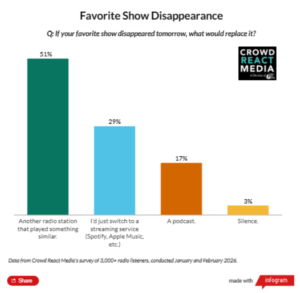
Here’s the benchmark: conversion needs to be 40 to 50% to run a healthy station. That’s your passionate core – the people who come back week after week. The other half are casual listeners. Some days, with the right content, you convert them. Some days they churn out. That’s normal.
The mistake is thinking you have to choose. You don’t. You need the passionate fans to create credibility and stability, and you need the casuals because some of them will become tomorrow’s P1s. It’s both working together.
Versus Digital
Keith: When measured against digital platforms, where does radio legitimately win and where does it often struggle or lose?
Katie: Here’s the thing – if we think of radio as separate from digital, we’ll lose every time. Radio shouldn’t be competing against digital platforms, it should be using them. We shouldn’t think in silos. You’ve spent decades building brand equity, as well as trust and credibility in your market – why would you throw the baby out with the bathwater by treating digital as some foreign territory?
I know you’ve read a thousand articles telling you that you need to go digital. But it’s really important to actually do it, not just nod along. My advice? Have some fun with it. Look at what other stations are doing on socials and YouTube – figure out what you like and what you don’t. No need to reinvent the wheel. Steal good ideas.
But also, play around on the platforms yourself. You need to understand the nuances. TikTok and Instagram Reels are ephemeral – you wouldn’t want to spend much time creating a video there that’s only relevant for 48 hours. But YouTube content can be evergreen. People return to it for years. That clip of your morning show hosts chatting about the latest pop culture news? Not something anyone will care about in a week. But that hilarious bit you did sending the intern around town getting man-on-the-street interviews about their relationship pet peeves? That could live on YouTube for years.
And get to know the power of algorithms. I mentioned TikTok’s Local Feed earlier – that’s a massive opportunity for local radio. But YouTube has one of the most well-honed algorithms in the tech world for getting content in front of people who are actually interested in it and find it relevant. Once someone interacts with your content there once, you get fed to them over and over and over again. That’s audience development you can’t buy.
Youth Gone Wild
Keith: No one seems to have a solution for the youth problem yet. What’s the core issue — content/product, platform and distribution, perception, commercials, personalization, or something else?
Katie: I think the question itself reveals the problem – we’re asking “What’s THE issue?” when it’s actually multiple things working together. But if I had to pick the biggest one? It’s that radio is waiting for youth to come to us instead of going where they already are.
Before we get into a spiral about the death of radio among younger audiences, let’s look at the actual data: our 2025 State of Media report shows radio listenership at 69% of 18-34 year-olds. That’s two-thirds of young adults still tuning in at least occasionally. In a top 50 market, you’ve got maybe 15-25 stations competing for that audience – a relatively concentrated playing field. Compare that to digital, where you’re competing with 10,000 influencers, endless streaming options, and algorithm-driven content. If you told me I could reach two-thirds of young adults through just 20 channels, I’d call that an advantage.
But back to the problem part. The issue isn’t that young people hate radio – it’s that radio isn’t meeting them where they are. They’re on TikTok & Instagram, so why aren’t weather updates and traffic showing up in Reels? They’re conditioned to interactive content, so why isn’t every contest integrated with social media?
We’re living in an incredibly fractured media landscape, and yes, audiences love options. But I believe we’re approaching a tipping point where the sheer volume of choices will drive people back toward trusted, local voices. Radio has that, decades of community credibility that no algorithm can replicate. But only if we stop thinking of digital as “not the mothership” and start thinking of it as the front door. Maybe a TikTok follower becomes a podcast subscriber, who eventually turns on the radio six months later. That’s not failure – that’s how audience development works now.
The core issue isn’t content, platform, or commercials. It’s that we’re still optimizing for how audiences consumed media in 2005, not 2026.
If Katie Ran Radio Stations
Keith: If you were handed control of a radio brand tomorrow, what’s the one business or structural thing you wouldn’t touch and what’s the first thing you’d change?
Katie:
Keep: The hosts.
Change: I’d make those hosts go to local concerts and events again. Get out there and connect with listeners in your town!
Also, I’d spend all your money on research. Kidding – but not really. Stations throw research out the window with the first round of budget cuts, and then wonder why they’re struggling. Are you really going to rely on a share metric that half of us don’t trust to tell you how your station is doing? This isn’t Gladiator – you can’t just get a thumbs up or down from Nielsen and learn anything useful.
You need research to actually speak with your audience. Find out what’s working, what’s not. Is your library stale? Do they hate all the new songs? (They do. The post-pandemic music drought is real!) What about the million other things you think may or may not be working? And let’s not forget sales research – SES, future purchase intent, all the ammunition your sales team can go out and sell on today.
Research isn’t a luxury. It’s how you stop guessing and start knowing.
Where Does Music Really Fit
Keith: Will formatted music still a big enough strategic and product differentiator to sustain radio 10 years from now?
Katie: Yes, but format alone won’t save you – how you deliver it will.
Think about yourself in high school. What mattered most to your identity? For a lot of us, that was music. We were the rockers, the pop kids, the goths, the rap lovers. That hasn’t changed. Younger generations still use music to define themselves, and we still look back at certain periods of our lives through the soundtrack that defined them. Music is deeply emotional. (The only thing we miss about in-person music tests is the energy in those rooms when people have just listened to 500 hooks – music gets people PUMPED.)
So yes, formatted music still matters. People still identify as Country fans or Rock fans or whatever their tribe is. But here’s the thing – Spotify can deliver those songs too. What Spotify can’t deliver is the combination of YOUR music, local connection, and compelling personalities who understand your market and your tastes. That’s radio’s edge.
I don’t see anyone besides radio pulling off that combo, unless you count a few radio-like shows on streaming platforms, which kind of proves the point. Playing titles in the digital void hasn’t beaten radio yet because it’s missing the human curation and local context.
If we lean into the digital tools we’ve been talking about and keep the format expertise paired with personality and localism, formatted music will be more than alright. The format is the foundation – how you build on it is what matters.
Sales Meetings
Keith: If you were advising a sales team, what metric should they truly lead with in meetings, what should they avoid more often, and what important metrics might be missing from their arsenal?
Katie: Lead with influence, not just reach. We conduct brand lift studies all the time, measuring the impact of campaigns across different media. Radio campaigns consistently overperform. A radio ad is more impactful than the same ad on other platforms.
Here’s how we test it: we surround the ad with five minutes of the station’s actual content, then measure listener response. Radio always provides a strong lift because the campaign lives within the bubble of their trusted hosts, shows, and station. That trust transfers directly to the advertiser. It’s not just impressions – it’s credibility by association.
This is doubly true for Spanish-language and Black radio audiences, who often have even stronger relationships with their hosts and stations. The loyalty and trust run deeper. And don’t get me started on what happens when you actually have an influential host read the ad or give it their own spin… *chef’s kiss*.
That’s the metric missing from most sales arsenals – proof of influence, not just proof of reach. Share or cume numbers tell advertisers you delivered eyeballs. Brand lift studies tell them you moved the needle.
Future Indicators
Keith: Is there any audience behavior or advertiser spending data you think radio should be watching closely right now?
Katie: Radio should be obsessively tracking brand lift performance. Not just conducting the studies but watching the trends. We’re seeing radio campaigns consistently outperform other media in brand lift, but most stations aren’t weaponizing that data. Track your brand lift performance over time, compare it to digital channels, and use that as your competitive differentiator with advertisers. The stations winning right now are the ones that can walk into a meeting and say “Here’s proof we move the needle better than Facebook ads.” That’s the metric that matters in 2026.
If Radio Were a Startup
Keith: If radio were a Silicon Valley startup right now, what would it build differently based on everything we now know from decades of data?
Katie: We’d build it platform-agnostic from day one. TelevisaUnivision’s President of U.S. Networks just said their most relevant metrics are “total multiplatform consumption measured in total viewing hours” – they’re competing for time spent, not just linear ratings. That’s the right approach, and radio should steal it.
If we were starting fresh today, we’d build:
- A unified content system, not simply a radio station. The core product is the brand and the voices, not the 99.3 FM signal. Distribution would be everywhere simultaneously. Morning show interviews become podcast episodes, become social clips, become YouTube content. One recording session, five distribution channels. We’d design for content to flow seamlessly across platforms rather than treating each as a separate silo.
- Total audience measurement, not just Nielsen. We’d track streaming hours, podcast downloads, social engagement, website traffic, and yes, OTA ratings – then aggregate them into one “total consumption” metric. We’d measure success by total time spent with the brand, regardless of where it happened. That’s what advertisers actually care about anyway.
- Research as strategy, not just ratings validation. We’d build in brand lift studies to prove advertising impact. And we’d constantly test the boundaries – where is your audience going when they’re not with you? What platforms are they adopting? What content are they consuming? Research wouldn’t just tell you how you’re doing, it would tell you where your audience is headed so you can get there first. It’s the difference between reacting to what happened and anticipating what’s next.
- Local connection as the differentiator. Silicon Valley can build algorithms. They can’t build trusted local relationships. We’d double down on hyperlocal content, community events, and personality-driven storytelling – the things streaming services can’t replicate.
I know this seems like a ton of work, and it is. But we increasingly have AI tools that can handle large parts of these lifts, especially content distribution and editing, so I’d encourage everyone at stations to get familiar and comfortable with these tools. My AI rule? Never create content, only refine.
The Unasked Questions
Keith: Experts say data is only as good as its interpretation, but it’s also true that data is only as good as the questions being asked. Is radio generally asking the right questions and are there difference-maker questions missing you believe should become more regular?
Katie: Radio stations often want to unlock all the secrets with the perfect set of questions, but if your order is wrong, you’re out of luck.
The biggest hurdle we face with clients is wanting all of their research, all at once. I get it, you don’t get many chances to talk directly with your audience in a critical setting like a research study, so you want to maximize it. But cramming everything into one massive study is how you end up with answers that don’t actually help you.
Research has to be sequential. It’s important to know your station’s position before you dive into your content. For example, if only 10% of the market is aware of your station, it really doesn’t make sense to spend resources refining your morning show hosts to the nth degree or testing music tilts. We’ve literally seen stations agonize over three different morning show concepts when their real problem was that 85% of the market didn’t even know they existed. That’s not a morning show problem. You need foundational research first – understanding holes in the market, defining your image, figuring out why people don’t know you exist.
But if we skip that first step and jump straight to the sexy stuff – talent testing, music research, perceptual mapping – we’re optimizing details while missing the big picture. You could have the perfect morning show that nobody knows about because your brand positioning is wrong.
The right questions matter, absolutely. But asking them in the wrong order is like trying to paint a house before you’ve built the foundation. Get the strategic baseline first, then you’ve earned the right to get granular.
To get weekly updates from Crowd React Media, click here.
Barrett Media produces daily content on the music, news, and sports media industries. Sign up for our newsletters to stay updated and get the latest information right in your inbox.

