
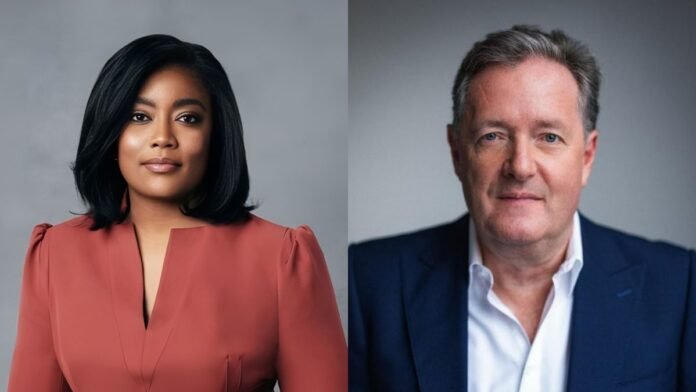
When Piers Morgan announced he’d hired former MSNBC president Rashida Jones as CEO of his Uncensored media brand, the easy reaction was to raise an eyebrow.
It’s a fair instinct. If you’re running what amounts to a YouTube show licensed out by the UK’s Channel 5, why exactly do you need a CEO? More to the point, why do you need one who’ll likely command the kind of salary that comes with Jones’s pedigree?
The skeptic’s argument writes itself. It feels like corporate window dressing — a move designed to make the operation look more legitimate than it actually is. Slap an executive title on someone prominent and suddenly you’re a media company instead of a guy with a camera and a grudge. That’s the cynical read, and it’s not entirely without merit.
But it’s probably the wrong read.
Look at the full picture, and something more intentional starts to emerge. Piers Morgan didn’t just hire a high-profile executive. He did it after securing more than $30 million in funding to back his venture. You don’t raise that kind of capital and then hire a former network president because you want your YouTube channel to look impressive. You do it because you’re actually trying to build something. Put those two moves together and the message is hard to misread: Piers Morgan has ambitions that extend well beyond an interview and panel show.
The question then shifts from “why does he need a CEO” to “what exactly is he building?” Jones isn’t a content hire. She’s an infrastructure hire. Her background is in running organizations, managing talent, and scaling operations. That’s not the profile you seek out if your ceiling is a niche digital talk show. It’s the profile you seek out when you’re trying to construct a media brand with multiple revenue streams, a real staff, and a long-term strategy.
There’s also a broader context worth acknowledging here. Morgan’s move isn’t just about his own ego — though there’s certainly some of that baked in. It reflects something that’s genuinely changed about the media landscape.
The democratization of content has made this kind of play possible in a way it simply wasn’t a decade ago. He doesn’t need a cable news contract. He doesn’t need a network executive greenlighting his projects. And he can take his content directly to consumers, build his own audience, and find a path to both relevance and profitability without anyone’s permission.
That’s a significant shift. For years, figures like Morgan needed traditional media infrastructure to remain viable. Now they don’t. The tools to distribute, monetize, and scale are accessible in ways they never were before. Some personalities have used that freedom to build genuine enterprises. Morgan appears to be betting he can be one of them.
Whether he succeeds is a different question entirely. Digital media is littered with well-funded ventures that never found their footing. Having money and a recognizable name isn’t a business model — it’s a starting point. Jones will need to translate Morgan’s notoriety into something sustainable, and that’s genuinely hard work regardless of how much capital is sitting in the bank.
Still, it’d be a mistake to dismiss this as vanity. The Morgan-Jones pairing is either the beginning of something real or a very expensive lesson in the limits of brand-building. Given the funding, the executive hire, and Morgan’s obvious hunger to remain a major media figure, it at least deserves to be taken seriously. He’s not just making a show. He’s trying to build an empire — and for the first time, he’s got the pieces in place to actually try.
Barrett Media produces daily content on the music, news, and sports media industries. Sign up for our newsletters to stay updated and get the latest information right in your inbox.

