

There’s nothing that brings a smile to my sports radio programmer face like a radio research project that points out the obvious, yet is often forgotten by those in power. When Audacy published its latest research concluding that it’s time to expand its target demographics to older listeners, it was a smile-and-nod moment for something programmers have known for at least a decade. Yesterday, I read Crowd React Media’s latest findings about what happens when a favorite radio show disappears and how listeners react.
Once again, it was a smile and a nod to something those on the ground floor understand, yet many in the C-suites often forget.
The data shows something that has been mentioned before: listeners pay attention. The way decision-makers cut talent without a proper chance to say goodbye matters to the stability and health of the brands they leave. More importantly, the research underscores why it’s more important than ever for talent to start thinking selfishly about their own future, rather than relying solely on the brands that house them (for now).
Let’s start with some stats from our friends at Crowd React Media. More than 3,100 people were surveyed, with 85% saying they would notice show changes within the first 24 hours. That’s a massive number and represents a couple of important realities that talent must understand.
The people who tune you in care about you and everything you entertain them with. Radio is a personal, one-on-one connection that invites the audience into your party.
The findings also show that the majority of the people listening to you are engaged with what you are doing at all times. That engagement doesn’t stop at the radio signal. It extends to the social side as well. Your listeners want real connections with you in everything you do.
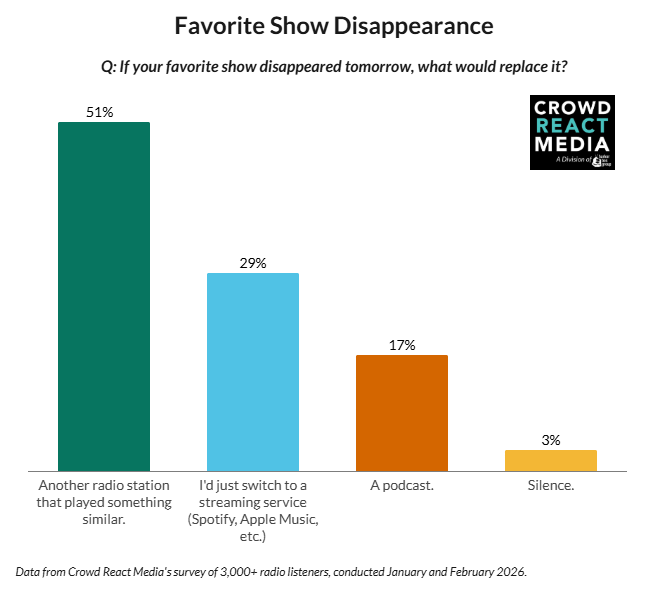
The second key finding focuses on where listeners go if their favorite show suddenly disappears. Fifty-one percent say they would look for another radio station offering something similar. In most markets, however, there are far fewer sports radio options than there are music formats. Twenty-nine percent say they would move to a streaming service, 17% would find podcasts, and 3% would choose silence.
I feel personally sorry for those 3%, and someone should probably reach out to them soon.
The most striking part of this data is the group searching for another radio station with similar content. The podcast number is equally important. Both findings highlight why it’s long past time for sports radio talent to start thinking more selfishly about their own future than the brand that currently signs their paycheck.
Sports radio isn’t classic rock. It’s not Top 40 or even Hot AC. Even in conversations with Cumulus Media and Westwood One Chief Insights Officer Pierre Bouvard, he notes that sports radio thrives because the content is new every time a listener tunes in.
Sports radio talent already hold an advantage when it comes to audience engagement because the format itself invites it. Sports fans naturally engage with voices that represent their passions and their teams. Just like fans follow their favorite band and celebrate every new release, sports audiences rally around personalities they trust.
If half of those surveyed say they would search for another sports option, they may struggle to find one on traditional radio. Only about 10% of radio listening occurs on the AM band. That means searching for another sports option often involves digging through static. If your station is on the FM dial, listeners are unlikely to switch to AM just to find something similar.
Listeners don’t want to work to find their entertainment.
That’s why more sports radio talent need to think about how they contribute content in the places audiences go when they aren’t listening to the radio.
The podcasting metric reinforces this point. When I managed talent — even while working for a large broadcasting company — I always encouraged them to think outside the walls. There’s far more opportunity to learn, grow and shape your media future if you think about how to build the mansion on another island.
Which raises a critical question: if your listeners move to podcasting when your show disappears, do you have a podcast that keeps that relationship alive?
Some sports radio talent have already started that process while still benefiting from the megaphone of radio. Far too many wait until the megaphone disappears.
If you wait for the pink slip, you start from scratch without the platform that once promoted you. That does a disservice not only to your audience but also to yourself. Why allow your audience to drift away entirely when attention spans are shorter than ever?
The reality is that radio brands are not investing nearly enough in building podcasts around their own talent. Instead, they lean on time-shifted audio and repackaged on-demand segments. That approach doesn’t create a podcast your audience can latch onto if — or when — the decision to cut staff arrives.
Don’t let that growing 17% go find a podcast that isn’t yours.
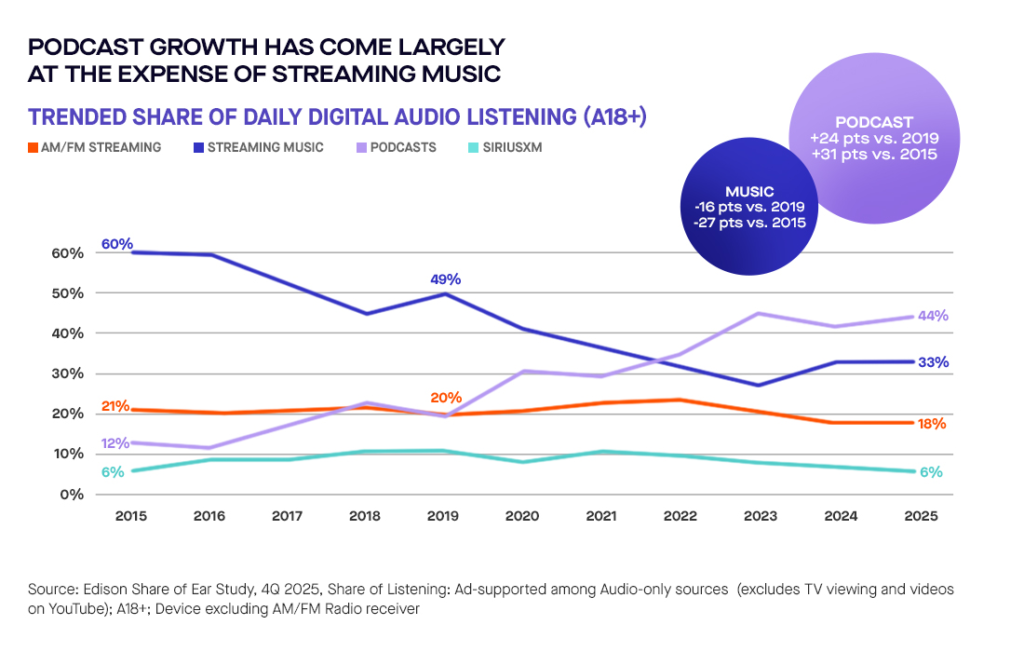
Audacy released a study yesterday showing that podcast consumption among adults has increased nearly fourfold over the past decade. Today, more adults 18 and older spend time with podcasts than with streaming music, streaming AM/FM radio or satellite radio.
And it’s not just about listening. It’s about revenue.
According to Audacy’s findings, 76% of podcast listeners say they have purchased a brand after hearing a host-read advertisement.
Sports radio talent are among the most trusted voices on broadcast radio. Taking your brand into podcasting now gives you the opportunity to capture a larger share of that advertising pie rather than relying solely on talent fees tied to a base salary.
If you don’t own the migration path now, it will only be because you chose not to.
That alone should bring a smile to the face of every sports radio talent. The real question is simple: if not now, when will you start building your future?
If there’s a lesson buried in all of this research, it isn’t complicated. Listeners notice. Listeners care. And listeners follow people far more than they follow logos.
That’s the part spreadsheets often miss.
The connection that powers sports radio has never been the transmitter, the brand name on the building or the corporate strategy outlined in a quarterly earnings call. It’s the host behind the microphone building a daily relationship with an audience that chooses to spend time with them.
Crowd React Media’s data simply confirms what the best programmers and talent have always understood: when a show disappears, the audience doesn’t just shrug and move on. They go looking for the voice they trusted. If they can’t find it on the dial, they’ll search somewhere else.
In 2026, “somewhere else” is no longer hard to find.
That’s why the smartest sports radio talent aren’t waiting for the industry to catch up. They’re already building their audience everywhere the audience already is — podcast feeds, social platforms and whatever comes next.
Because when the day comes that a station decides the show is over, the relationship doesn’t have to be.
And if this latest research proves anything, it’s that the audience would prefer it that way.
Barrett Media produces daily content on the music, news, and sports media industries. Sign up for our newsletters to stay updated and get the latest information right in your inbox.

